
Medina County Court Records After a Jail Arrest
After someone is arrested and booked into the Medina County Jail, the custody record is only the starting point. The jail roster can identify the person in local custody, show available booking filters, and sometimes reflect arrest or hold information. The formal Medina County court records after an arrest begin when the right court or prosecutor files or processes the charge. For felony cases, the Medina County Clerk of Courts Criminal Division manages and retains records, and the local research identifies two official felony pathways: an indictment issued by the Medina County Grand Jury or a bill of information filed by the prosecuting attorney.
Misdemeanor, traffic-criminal, and local ordinance cases may move through Medina Municipal Court or Wadsworth Municipal Court depending on the agency and location involved. Medina Municipal Court publishes Case Access for civil, criminal, and traffic cases, and its 2024 annual report shows that traffic and criminal filings came from agencies such as Brunswick City, Brunswick Hills Township, Medina City Police, Medina County Sheriff, Medina Township Police, Montville Police, and others. That local mix matters because a jail arrest by one agency can become a court record in a different court channel. Use jail inmate records for the roster and custody side, and use jail mugshots for booking photo questions. The court record is the case file: filed charges, case number, hearings, bond orders, pleas, dismissals, sentencing, and later case events.
How to Find Medina County Court Records After an Arrest
Start with the court that fits the charge level and location. Felony records are handled through the Medina County Clerk of Courts and the Odyssey/Tyler Public Access route. Probate, Juvenile, Common Pleas, and Domestic Relations docket searching is described on the official Probate/Juvenile online docket page, which says users can search by party name or case number. Municipal criminal and traffic cases are searched through Medina Municipal Court Case Access from the court homepage. The jail roster remains useful, but it should not be treated as the final court charge list.
- Open the relevant official court access route, such as the Medina County Clerk/Odyssey portal for Common Pleas felony matters or Medina Municipal Court Case Access for municipal criminal and traffic cases.
- Search by defendant name first. If a case number is available from paperwork, jail records, or court notice, use it to narrow the docket.
- Open the matching case and read the filed charge list, case type, court dates, bond entries, and disposition entries.
- Compare each charge with any booking charge on the jail roster, because filed charges can be amended, reduced, dismissed, or replaced by indictment or information.
The statewide ODRC Offender Search is not a county court docket, but it becomes relevant after a sentence to state prison or supervision. Ohio VINE at https://vinelink.vineapps.com/state/OH is a notification layer for custody and case updates. For sheriff booking or incident records that are not online, the Medina County Sheriff's Office, led by Sheriff Terry Grice, uses its public records process as the records fallback under Ohio's Public Records Act.
| Question | Official Channel |
|---|---|
| Current adult jail custody | Medina County CentralSquare inmate portal or inmate information at 330-764-3628. |
| Felony case record after arrest | Medina County Clerk of Courts and the Odyssey/Tyler Public Access route for Common Pleas records. |
| Municipal criminal or traffic case | Medina Municipal Court Case Access, or Wadsworth Municipal Court if that jurisdiction applies. |
| Missing booking, incident, or historical sheriff record | Sheriff public records request and the sheriff public records policy. |
| State prison, federal custody, or ICE detention | ODRC Offender Search, BOP inmate locator, or ICE ODLS, depending on the custody system. |
The official Medina Municipal Court homepage is one local route for criminal and traffic case access after an arrest in the municipal court system.
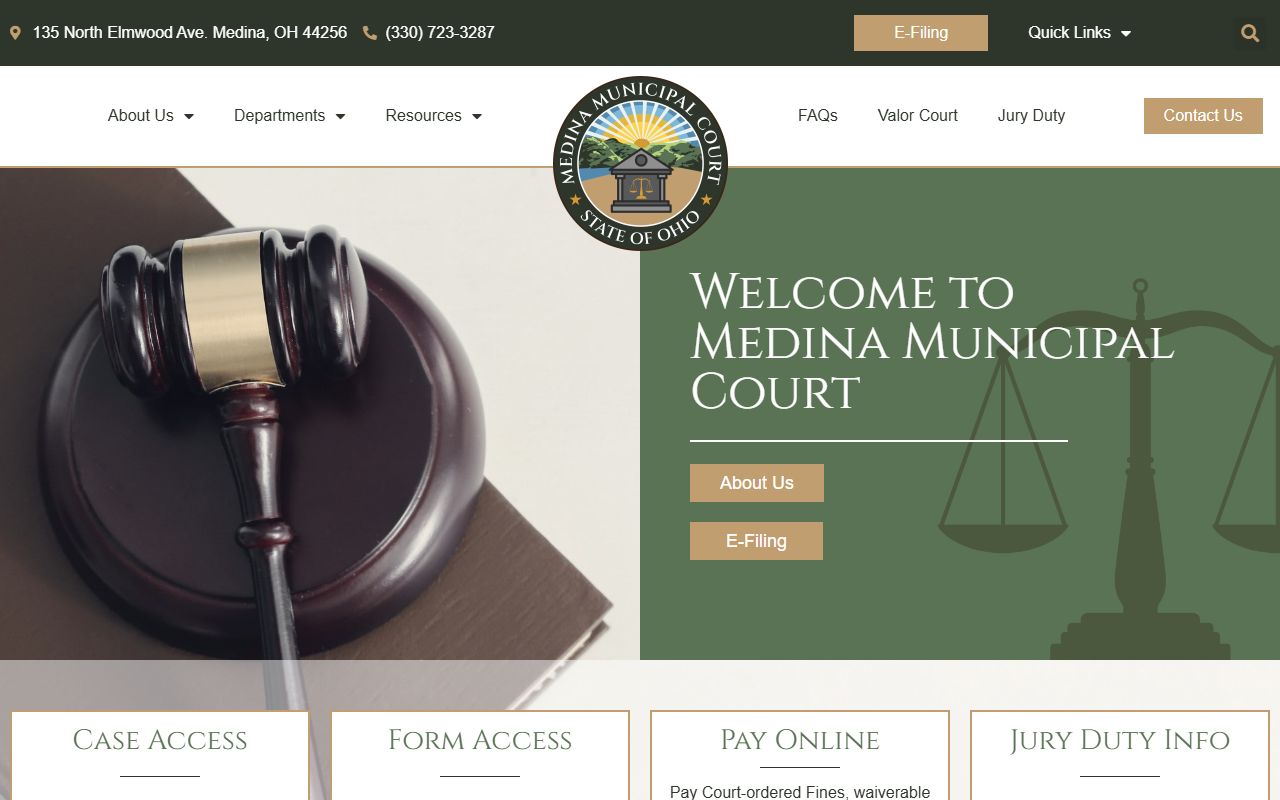
Use that court source for municipal criminal or traffic dockets, then return to the sheriff roster only for current jail custody questions.
How Charges Get Filed After an Arrest: Complaint, Information, and Indictment
The arrest and intake process creates jail records, but the charging document starts or advances the criminal case. In Medina County felony matters, official Clerk language says prosecutions begin with either an indictment from the Medina County Grand Jury or a bill of information by the county prosecuting attorney. Complaints can also start criminal proceedings, especially before a felony is indicted or in misdemeanor contexts. The Medina County Prosecutor's Office is led by Prosecutor S. Forrest Thompson and includes Criminal, Civil, Juvenile, Child Support Enforcement, and Victim/Witness Advocate divisions. The criminal division is the key local office when a felony arrest becomes a filed court case.
| Complaint | Information | Indictment | |
|---|---|---|---|
| Filed By | Law enforcement or prosecutor, depending on the case and court process. | Prosecutor, when the case may proceed by bill of information. | Grand jury, after the prosecutor presents the matter. |
| Common For | Misdemeanors, early felony filings, warrants, or initial court processing. | Felony cases where the defendant can be charged without grand jury indictment as allowed by law. | Serious felony matters filed in Medina County Common Pleas Court. |
| Starts | An initial criminal case or charge record. | The Common Pleas felony case by prosecuting attorney filing. | The Common Pleas felony case after grand jury action. |
Charge Status and What It Means
Charges can change after a jail arrest. The roster may reflect the arresting agency's booking language, while court records show what the prosecutor files and what the court does with each count. A charge may remain pending for months, be amended to a different code section, be reduced in plea negotiations, be dismissed, or end in a conviction after a plea or verdict. Bench warrants and capias entries may also appear in the docket if a person misses court or violates a release condition.
| Status | What It Means |
|---|---|
| Pending | The charge is unresolved. Future hearings, plea negotiations, trial dates, or prosecutor action may still occur. |
| Amended / Reduced | The charge was changed. A reduced charge usually means a lesser offense replaced or resolved the original count. |
| Dismissed | The charge was terminated without a conviction on that count, although other counts or cases may remain active. |
| Nolle Prosequi | The prosecutor formally chose not to proceed with the charge. The docket entry controls the exact effect. |
Bond and Release After an Arrest
Bond is controlled by the court process, not by a generic website list. Medina County sheriff sources reviewed did not publish a jail-specific bond payment schedule or accepted jail bond methods, so exact payment instructions should be verified in the court docket, with the relevant court clerk, or through Medina County Jail inmate information at 330-764-3628. A person may appear on the roster while waiting for first appearance, arraignment, a bond review, or release processing. Another agency hold can also prevent release even when bond is posted on the local case.
| Bond Type | How It Works |
|---|---|
| Cash Bond | Money is paid as ordered by the court to secure appearance and release, subject to court-specific instructions. |
| Surety Bond | A licensed bail agent or surety posts bond under Ohio rules. Medina research did not identify an official county list to republish. |
| PR / Own Recognizance | The person is released on a promise to appear, often with conditions set by the judge. |
| No-Bond Hold | Release is blocked because no bond is available or because another warrant, detainer, probation, parole, federal, ICE, or agency hold applies. |
Warrants That Lead to an Arrest
Medina County has two documented official warrant channels. The sheriff's CentralSquare warrant route is at https://portal-oh-medina-so.centralsquarecloud.com/warrants, and the portal bundle confirms a warrant module even though static inspection did not capture every field label. Medina Municipal Court also publishes a Most Wanted page with monthly poster information and a warrant hotline at 330-722-5870. A warrant can lead to jail booking, but the court docket should be checked for the warrant entry, bond order, recall, dismissal, or later case status.
The official Medina County sheriff warrant portal is a separate route from the jail inmate portal.
Use the warrant portal and the court docket together, because a public warrant listing may not show the later court action that clears, recalls, or replaces the warrant.
Charges vs. Convictions
A Medina County arrest and a filed charge are not the same as a conviction. A charge is an accusation supported by the legal standard needed to begin or continue prosecution. A conviction requires a guilty plea, finding, or verdict accepted by the court. Court records after a jail arrest may show serious allegations, but the docket must be read through the final disposition before drawing conclusions about the outcome.
| Charge | Conviction | |
|---|---|---|
| Stage | Accusation filed or pursued after arrest. | Final guilty plea, finding, or verdict on a count. |
| Burden of Proof | Probable cause or charging standard, depending on the step. | Beyond a reasonable doubt for trial, or a valid accepted plea. |
| Public Record | Usually public unless sealed, juvenile, confidential, or otherwise exempt. | Usually public unless sealed, expunged, juvenile, or otherwise restricted. |
Sealed vs. Expunged Arrest Records
Ohio sealing and expungement are court processes. ORC 2953.32 is the key statute identified in the Medina research for eligible conviction records, and the exact eligibility depends on the case, timing, offense, and court order. Sealing limits public access. Expungement is a stronger remedy where authorized and can involve deletion or destruction of records. A dismissed case or eligible disposition does not automatically erase every sheriff, court, jail, or third-party copy without the proper legal process.
| Sealed | Expunged | |
|---|---|---|
| Visibility | Public access is limited by court order or statute. | The record may be deleted or treated as removed where Ohio law authorizes expungement. |
| Law Enforcement | Some government or law enforcement access may remain for limited purposes. | Access is more limited, but the order and statute control. |
| Eligibility | Depends on Ohio law, the charge, outcome, waiting period, and case history. | Depends on whether the record is eligible for expungement rather than only sealing. |
Background Check Considerations
Casual court lookup and regulated background screening are different uses. Court records, jail records, ODRC records, and warrant pages can help locate official public information, but employers, landlords, insurers, creditors, and others using information for FCRA-covered decisions must use proper consumer-reporting procedures and comply with applicable law. A docket entry should also be verified against the originating court before it is relied on for any serious decision.
Important: This private website is not a consumer reporting agency and cannot be used for credit, employment, tenant, insurance, or other FCRA-covered screening.
Restricted Court Records After an Arrest in Medina County
Some records are not available through public case search or the jail roster. ORC 149.43 gives broad access to public records but also excludes categories such as confidential law-enforcement investigatory records, trial-preparation materials, medical records, and other protected records. ORC 2151.14 separates juvenile court records from adult jail and criminal case searching, which is why the Medina County Juvenile Detention Center should not be treated like the adult jail roster. Sealed records, protected victim or witness information, medical or mental-health details, and active investigative material may be withheld or redacted. The Medina County Sheriff's Office public records policy says denials and redactions must identify the legal authority, and the correct next step is to contact the originating office or court rather than assuming the record never existed.